
This educational guide is written by the Meadow team at Ostra Health. It has not been reviewed by a clinician and does not provide medical advice.
Start with a short personal list
A trigger note is useful when it is specific and repeatable. Pick three to five candidates you already suspect, such as short sleep, a skipped meal, alcohol, a strong scent, or a pressure drop. Log those. Ignore the rest until one of them shows up again.
If every attack carries ten tags, every tag looks important. The pattern disappears into the checklist.
Look across weeks, not one bad day
A trigger hypothesis needs both kinds of days: days with the suspected factor and an attack, and days with the factor and no attack. One coincidence is not a pattern. Rank the tags that keep showing up beside attacks over several weeks.
The gap between attacks is a separate question. The days-between calculator measures that gap. It does not explain why the gap changed.
A worked example
You suspect skipped lunch. Over four weeks you skip lunch six times. Attacks follow four of those days and also happen on three days when you ate on schedule. The honest summary is: skipped lunch showed up often, and it does not explain every attack. That is a better note for a clinician than 'food is my trigger.'
Retire a tag that never repeats. Add one new candidate only after the first list has been stable for a few weeks.
How Meadow shows this, and the limit
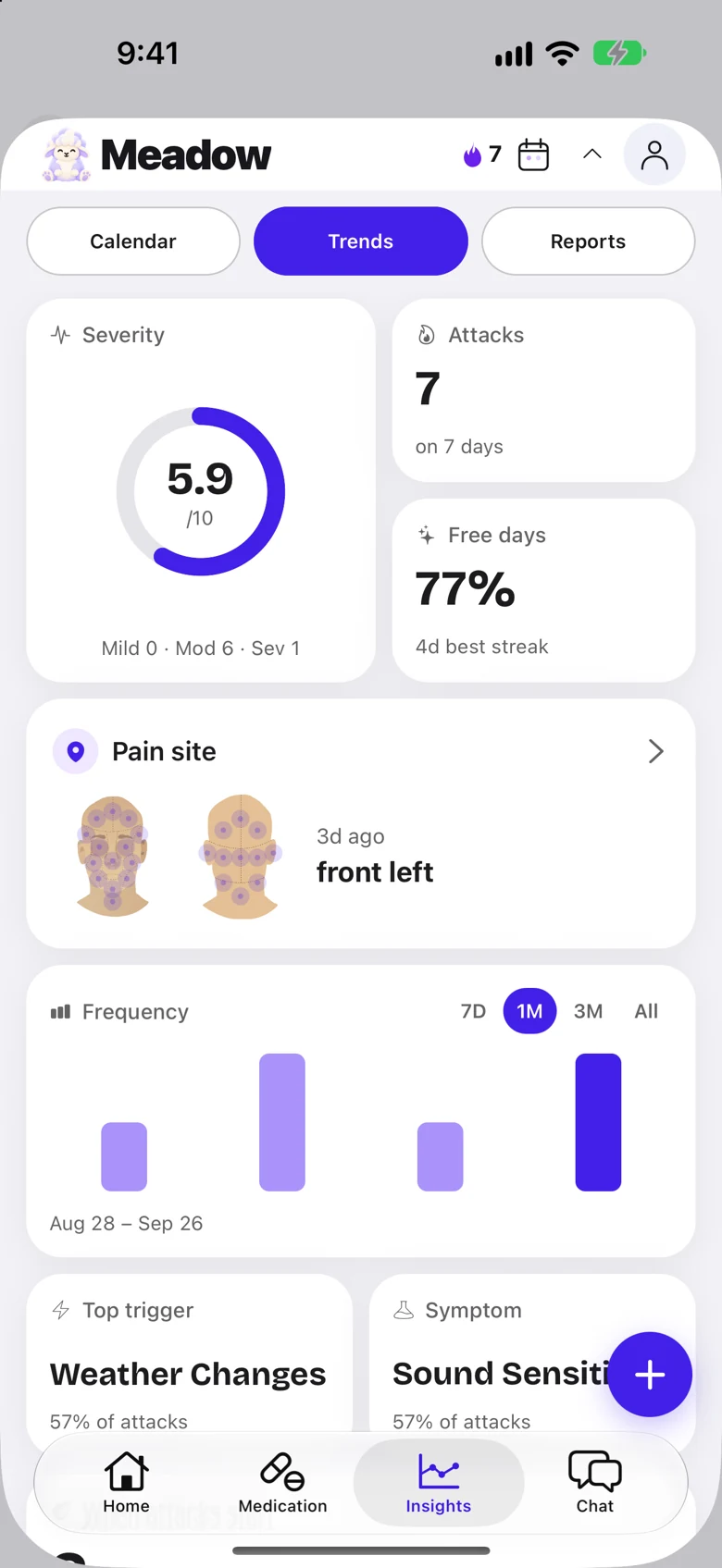
Meadow can rank the triggers and symptoms you chose to log, next to attack counts over time. The ranking is a count of what you entered. It is not a causal finding and it is not a diagnosis.
Weather can be attached automatically when location is on. Everything else still depends on you tapping it. Meadow will not invent a trigger you did not record.